
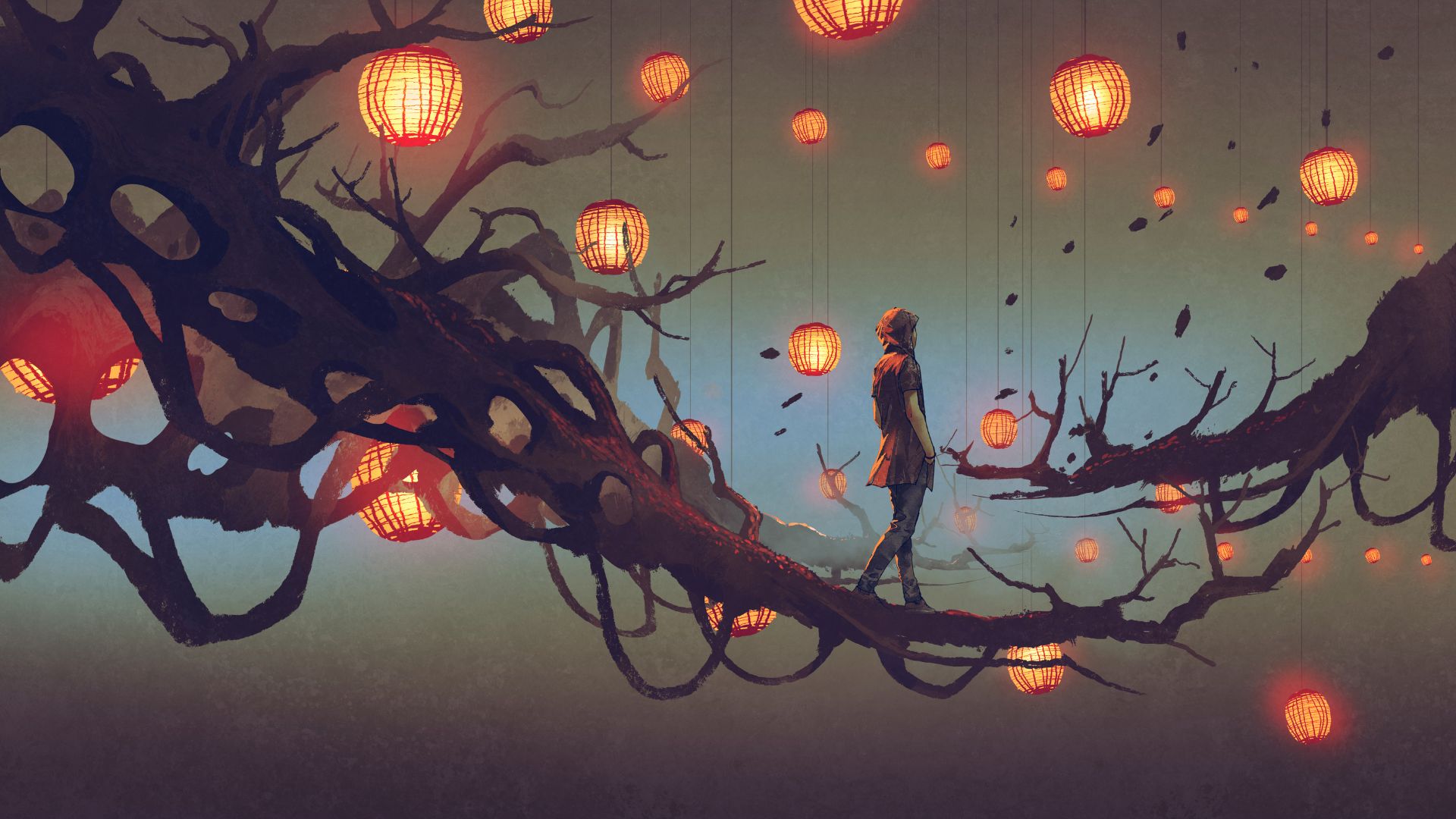
You have been pulling for years. The trap was never designed to let you out that way.
The Toy That Teaches You Backwards
You have held one. A small tube of woven bamboo, striped red and yellow, the kind handed out in party bags. You slid a finger into each end, and someone said: now pull.
So, you pulled. The weave tightened around both fingers, and the harder you pulled, the tighter it gripped, until your fingertips went pink and faintly numb and you were laughing in that panicked way children laugh when a game stops being a game.
Nobody tells you the trick. You find it by accident, usually at the exact moment you give up. Your arms tire, your hands drift towards each other, and the tube goes slack.
The way out is in.
Most of us learned that at about seven years old. Then we spent our adult lives forgetting it.
An Ordinary Afternoon at the Keyboard
I was at work, typing. No retreat, no candle, no sunrise over water. A screen, a half-written email, and a sentence that had been running underneath everything for a couple of years.
I’m stuck.
Not stuck in one corner of my life. Stuck in all of them. And I had become very good at monitoring it. I checked it the way you press a bruise. How stuck am I today? Still stuck? Any movement? None. Back to work.
Then, somewhere in the middle of a sentence I was typing, a different question arrived. It did not feel like an insight. It felt like someone setting a hand on my back.
What if this is exactly where I am meant to be?
My shoulders dropped. I had not known they were up.
What We Think Is Happening
When you feel stuck, the obvious explanation is that you are not trying hard enough. Not clear enough, not brave enough, not disciplined enough. So, you do what capable people do. You try harder.
Another course. Another plan. Another five o’clock alarm. A vision board, a coach, a fresh notebook with the first page left blank for the breakthrough. A long walk where you finally think it all through and come home having thought it all through again.
You know the moment it starts. Sunday evening, the week laid out in front of you, and the feeling lands in your stomach before you have even named it. Same job. Same conversation you keep not having. Same version of you, a year older. So, you open the laptop and start a new document called something hopeful, and you sit looking at the cursor.
Look closely at every one of those efforts and you will find the same word folded inside it. Stuck. You cannot plan your way out of something without holding it in mind. You cannot measure your progress away from it without checking, again, exactly where it is.
In June I wrote that you were not stuck, that you were simply hoping instead of moving. I still believe hope can become a very comfortable waiting room. But I was only half right. Plenty of us are not waiting at all. We are pulling with everything we have.
And the pulling is the trap.
What Is Actually Happening
In a small experiment run in 1987, university students were asked to spend five minutes not thinking about a white bear, and to ring a bell every time they did. They rang it often. Then came the part nobody expected. The students who had first tried to push the thought away went on to think about the bear more than students who had been allowed to think about it freely from the start.
The study was small and the bear was trivial. But it captured something every one of us has lived. Trying not to think about a thing keeps it in the room, because the mind has to keep checking whether it has gone.
That is the weird loop of feeling stuck. Every attempt to get out requires you to look at it. Every look confirms it. Every confirmation makes the next attempt more urgent. You are not escaping the narrative. You are keeping it alive, feeding it every morning before coffee.
And a story you tell yourself that often stops being a story. It becomes the lens. You walk into a room already knowing what you will find there, and so you find it. Not because you have conjured anything, but because a mind that is always searching for proof will always find some.
You cannot leave a place you are still at war with.
What It Costs
The cost is not only time, though a couple of years is a long time to hold your hands that far apart.
It lives in the body first. The shoulders that have quietly taken up residence near your ears. The jaw you clench while you sleep. The breath that never quite reaches the bottom of your lungs, because some part of you is braced for a fight that never arrives.
Then it takes your attention. When all of your energy goes into the pull, there is nothing left to notice what is actually around you: the conversation that could open something, the idea that turns up on a Sunday, the door standing slightly ajar while you strain at the one bolted shut.
And for high achievers, it costs something harder to name. Fighting feels like virtue. As long as you are struggling, you are still a person who tries. To stop would feel like admitting you were never going to win.
So, ask yourself, and stay with the answer before you move on. How many times today have you checked how stuck you are? What has all that pulling protected you from finding out?
“So, I Just Give Up?”
I can hear the objection, because it was mine. So, I just accept it? Sit here and call it wisdom? That is resignation with better lighting.
It is not. And the research is surprisingly precise about why.
In a study of more than 1,300 adults, people who habitually accepted their difficult emotions and thoughts, without judging them or trying to force them away, experienced fewer negative emotions and better psychological health overall. Those who tried to avoid their negative feelings reported more symptoms of mood disorders six months later.
Here is the detail that matters. The researchers were measuring acceptance of thoughts and feelings, not of circumstances. Accepting the difficult situation itself was not what predicted wellbeing. Accepting your own inner response to it was.
So, you are not agreeing that your life must stay this way. You are agreeing to stop fighting the fact that, right now, this is how it feels.
Resignation says nothing will ever change. Surrender says I will stop fighting the fact that it has not changed yet.
What if this is exactly where I am meant to be? asked in despair is a sentence of defeat. Asked in curiosity, it becomes a door.
What Changed, and What Did Not
I would love to tell you that everything moved that afternoon. It did not.
I was still at the same desk. The same questions were still unanswered. In the plainest sense of the word, I was still stuck.
But something in the room changed. It was as if someone had raised a blind I had not noticed was down. More light, the same furniture. My breath went lower. The low hum that had played underneath everything for two years went quiet for long enough that I could hear what else was there.
And over the weeks that followed, things began to move. Not because I pushed them. Because I had stopped spending every ounce of my strength on the push.
Here is the complication I will not hide from you. Some mornings I catch myself pulling again. The old checking comes back before I have even opened my eyes properly. How stuck am I today? The difference is not that the question has gone. The difference is that I now notice my hands are pulling, and I know which way to move them.
That is the work. Not one surrender, done beautifully, once. A small turning inward, as many times as it takes.
What if this is exactly where I am meant to be? I still ask it most mornings. It no longer sounds like a verdict. It sounds like permission to stop.
Who would you be if you were no longer someone trying to get unstuck?
One Thing to Do Tonight
Take a piece of paper and write one sentence on it.
I am stuck in ________, and this is exactly where I am.
Fill in the blank with the truest thing you know. Then stop. Do not write a plan underneath it. No bullet points, no goals, no “but”. Read it aloud once, slowly, in the voice you would use with a friend.
Then put the pen down and leave the page where it is until morning. Notice what your shoulders do.
That is the whole step.
The Way Out Is In
Go back to the tube of woven bamboo for a moment.
It never loosened because you got stronger. It loosened because you stopped trying to leave. Your fingers moved towards the very thing holding them, and the weave had nothing left to grip.
You have been pulling for a long time. You are tired, and you are entitled to be.
So here is the question again, one last time, and it has changed since you first met it.
What if this is exactly where you are meant to begin?
The way out is in.
If this resonated, I would love to continue the conversation.
You can explore my 1:1 coaching work here, or browse more writing on the blog.
Catherine